Sunday, September 5, 2021

The Impatient Chef Cocktail Recipe: Just Peachy


The Impatient Chef bought a new gin last week. It is called Wild Roots Cucumber and Grapefruit Gin. Since Wild Roots London Dry Gin is the Impatient Chef’s favorite martini gin, even beating out Tanqueray, it was natural to try their other gin.

The Cucumber and Grapefruit Gin is decidedly different.

Tasting notes:
  • Bitter cucumber, 
  • A hint of grapefruit, and 
  • Some juniper. 
  • It boarders on sour, like a Genever gin, but does not go all of the way there. 
The Impatient Chef loathes Genever gins.

Genever is an older form of gin that largely died out in the US after Phohibition as new distilleries catered to a changed taste in liquor among Americans once freed from the 18th Amendment. Genever remained in production in Europe, and eventually returned to the US with Bols Genever, Aviation Gin, and 12 Bridges by Integrity Spirits (now defunct). It is known for its sourness.

The Impatient Chef still loathes Genever gins.

Wild Roots' Cucumber and Grapefruit Gin’s odd flavor made it a challenge to design a drink around. It clearly could not be the dominant flavor, so a martini was out.

The method:
  • Pour 1/2 oz of the gin into a shot glass. 
  • Taste it with 3 small sips about a minute apart. 
  • Decide whether flavors added should be complimentary, or overpowering. 
I opted for complimentary. The first selection was simple syrup. The Impatient Chef does not go for sweet drinks as a rule. However, simple syrup seemed necessary. The second selection was lemon juice, which would offer a little acid, and tartness. Lastly, a flash of inspiration, and a reason to use another Wild Roots spirit, led me to their Peach Vodka. 

Notes on Vodka: The Impatient Chef avoids it whenever possible.  There is always a more interesting flavor to put into a drink.  Vodka is the alcohol equivalent of Wonder Bread, and Wonder Bread is the equivalent of a flavor lobotomy.  Flavored vodkas are similarly avoided, unless it is New Deal Distillery's Hot Monkey Vodka.  

However, there was a bottle of Peach Vodka lying around after an elaborate dessert recipe steered itself over the guardrails and into the ravine.  So, why not?  

Here’s the recipe:
  • 1/2 oz lemon juice 
  • 1/2 oz simple syrup 
  • 1 oz Wild Roots Cucumber and Grapefruit Gin 
  • 2 oz Wild Roots Peach Vodka 
Shake with ice.

This drink works really well. The cucumber compliments the peach in a distinctive and surprisingly delicious way.  Don't think for a moment that the Impatient Chef is going soft on vodka, but this drink is surprising delicious, and quite refreshing.  If you live where you can get these spirits, give it a whirl.  

Enjoy!

The Impatient Chef

Sunday, June 13, 2021

The Impatient Chef Recipe - Paella!

Summer is here and the time is right for...
Paella!

The way to know when summer has arrived in my household is when the Paella pan comes out of hiding.

Paella comes from Spain, and has been taking hold in the US for the last decade, or so.  It seriously tries The Impatient Chef's patience, but the finished product is worth it.  This recipe is an amalgamation of a few different versions with some additions (shrimp and chorizo) of my own that turned out to not actually be original.  Oh well.  For me, they are indispensable.  

Ingredients:

  • 1 pound tomatoes, or a 16 oz can diced tomatoes 
  • 9 cups chicken broth 
  • 3 cups Bomba, Paella or Arborio rice.  Any of these would work.  
  • 20 threads saffron 
  • 2 sprigs rosemary.  Remove the leaves from the stems
  • 3 teaspoons kosher salt
  • 1 teaspoon smoked paprika 
  • 2 tablespoons olive oil 
  • 3 pounds bone-in, skin-on, chicken thighs
  • 1 pound ground pork chorizo sausage (optional, but why would you not use it?) 
  • 1 pound medium to large shrimp (optional, but… well… it’s shrimp!) 
  • 1/2 pound fresh green beans, ends cut off, and cut into 1" pieces
  • 2 cups chopped red bell pepper 
  • 7 cloves garlic, minced 
Equipment: Chimney starter, paper, and about 4 pounds natural lump charcoal, 15-inch carbon steel paella pan, kettle grill.  

Directions:

  1. Start the grill:  Crumble some paper (I use Visa receipts because they can't be recycled), and put it into the bottom of a charcoal chimney starter.  Fill the chimney with half of the charcoal and light the paper.  
  2. When the charcoal is looking ashy, pour it onto the bottom grate of the grill and spread it out.  Add the remaining charcoal, and spread it evenly.  Add the cooking grate to the grill, but don't put the Paella pan onto it yet.  
  3. You need to give the coals a little time to settle down before cooking, so its important to start the coals first.  You can start the prep while they are in the chimney, but make sure you give them some time.  My most recent Paella suffered from forgetting to do this.  I had the Fires of Hell under the pan when I started, and it it was difficult to get everything done without burning.  I lost about a third of the batch to over-charring.  There is supposed to be a layer of "socarrat", or lightly-charred rice, on the bottom of the pan.  There is not supposed to be a layer of creosote.  
  4. Start your prep:  If you use fresh tomatoes, just dice them.  I have always done well with using canned, diced tomatoes. You can also use ground tomatoes as well.  Do all of the chopping and cutting mentioned in the ingredients list.  

  5. Season the chicken with 2 teaspoons of salt.
  6. Warm the chicken broth in a saucepan over medium heat until it reaches 200 degrees F.  Put on the lid, and turn the burner to low, or just remove it from the stove.  
  7. In a mixing bowl, add the rice, saffron, rosemary, 1 teaspoon of the salt, and paprika.  mix it with your hands for a few seconds.  
  8. Put your Paella pan onto the grill.  Let it heat for a few seconds.  
  9. Add the olive oil to the pan (remember, no Fires of Hell). 
  10. If you are using chorizo and shrimp, cook this first for 4 minutes.  If the shrimp is raw, add it to the chorizo after 3 minutes.  Remove both to a bowl for later, leaving the spicy oils in the pan.  If the shrimp is precooked, add it when you add back the chorizo in a few steps.  
  11. place the chicken into the pan, and fry until golden brown on both sides.  It should take about 5 to 6 minutes per side.  

  12. Remove the chicken from the pan, and set aside.  Add the green beans, and red bell pepper to the center of the pan and cook until they begin to soften and darken in color, approximately 2 to 3 minutes.  Add the garlic and stir for an additional minute.  
  13. Add the tomatoes, and cook until most of the liquid is gone.  This is usually just a few minutes.   
  14. Add the rice mixture to the center of the pan and cook, stirring constantly for 1 minute.  
  15. Add back the cooked shrimp and chorizo at this point, and spread the rice mixture evenly throughout the pan.  
  16. Place the chicken pieces on top of the rice, and press down lightly to nestle them into the rice.  They should not touch the bottom, though.  
  17. Add 4 cups of the warm chicken broth, and make sure that the rice mixture is still evenly distributed.  The rice should be completely submerged in the liquid.  You can press it under the liquid with a spatula or long spoon if necessary.  Do not stir the paella from here on.  To get socarrat, you have to leave it undisturbed.
  18. After about 8 to 9 minutes, the liquid should be mostly absorbed.  Add 4 more cups of broth.  Cook for 8 to 9 more minutes without stirring. The rice should be al dente at this point.  Distribute the remaining cup of broth.  Add a little to spots where the rice is poking through the liquid. 
  19. After a few more minutes, you should hear a light sizzling from the bottom of the pan.  If you don't hear it, don't worry.  The rice shouldn't look soupy, but it also should not be totally dry.  It should look like the picture below.  
  20. Remove the pan from the grill, and cover it with a couple of kitchen towels.  Leave it rest for about 15 minutes.  Any remaining liquid should be absorbed by the rice.  

It may take a few attempts to get it right, but it is rewarding, and will feed an army, or give you a week of leftovers.  

Enjoy!

The Impatient Chef.  


Saturday, June 12, 2021

The Impatient Chef Presents: Cadillac Ham with Grits and Red Eye Gravy


Swimming in Coffee!

The Impatient Chef has been experimenting with southern cooking for a few years, having watched Sean Brock on Parts Unknown and a few other cooking shows. A Cajun seafood boil at a local restaurant called “My Brother’s Crawfish” also played a big role in nurturing the southern foor urge.  

Sean Brock is a southern chef who has taken southern cuisine back to its roots and to new heights. The Impatient Chef suggests seeking his cookbooks out. 
 

Brewing up a new take on an old dish.


The Impatient Chef likes to, as it were, fiddle with traditions while culinary Rome burns. The following recipe is an example. What would happen if the ante on the ham was, as it were, upped.

The word “Cadillac” is used mostly with cocktails to denote expensive drinks that use premium spirits. The Impatient Chef once bought a Cadillac Margarita at a local upscale restaurant. It was very good.

With that in mind, The Impatient Chef presents: Cadillac Ham with Grits and Red Eye Gravy. 

Feeds 2.  

Ingredients:
  • 1/2 lb slab of prosciutto, about 3/8” thick.
  • 2 eggs 
  • 1/2 cup Anson Mills Coarse White Grits 
  • 2 cups water 
  • 1/2 tsp kosher salt 
  • 1/2 tsp white pepper 
  • 3/4 cup freshly brewed coffee 
  • 2 dashes cayenne pepper 
  • vegetable oil 
  • olive oil 
  • 1 tbsp butter 

Directions:

  1. Anson Mills Coarse Grits require an overnight soak and careful cooking the next morning. The Impatient Chef grits his teeth, and uses these very patient grits because they are really good. You will find the recipe for making them here: https://ansonmills.com/recipes/489?recipes_by=grain. If you do not have the patience, use Bob’s Red Mill White Grits because they are a close second. Impatience ≠ bad food. For Bob’s Red Mill Grits, add the salt and pepper about half way through cooking. 
  2. While the grits are cooking, cube the prosciutto. 


  3. Make coffee. Set aside 3/4 cup. Add 2 dashes cayenne pepper to it.
  4. When the grits are almost done, add the salt and pepper.  Stir.  
    Note: If you use the Anson Mills grits, wait until they are just about done to start frying the prosciutto. They take about 50 minutes if you follow the directions, and about an hour and a half if you don't. 
  5. Heat an iron skillet on medium high, and add a couple teaspoons of vegetable oil, or, better yet, bacon grease.
  6. Fry the prosciutto until the sides are browned like almost-done bacon. Do not fry it crisp because it will become too hard, but you want to have fond on on the bottom of the pan to deglaze with the coffee. Remove from pan when browned. 
  7. Pour the coffee into the skillet and stir with a wooden spoon to deglaze. Work the bottom of the pan with the spoon until the fond is suspended in the coffee. Turn off the heat.  It is now red eye gravy. 
  8. Fry the eggs over easy, or however you like them in a couple of teaspoons of olive oil, or, better yet, bacon grease. 
  9. In two bowls, put half of the grits into each, followed by about a teaspoon of butter. Spoon on the fried prosciutto, and then lay a fried egg on top. Pour half of the red eye gravy onto each. 

Enjoy!
The Impatient Chef
Visit my photography website at www.quaygang.com

Thursday, June 10, 2021

The Impatient Chef Clam Chowder (and Fish & Chips) Review: Gracie's Sea Hag in Depoe Bay, Oregon

In this episode, we set out to find New England Clam Chowder in its natural habitat: The Oregon Coast.  

Really, why the Oregon Coast? Why not, say, New England?  

The simple answer is that The Impatient Chef does not have that much rocket fuel, but the best reason is that The Impatient Chef really likes the Oregon Coast.  

You may ask why The Impatient Chef reviews specific foods in a restaurant instead of reviewing the whole restaurant.  First, (why do you ask so many questions?) The Impatient Chef doesn't pretend to be able to deduce the entire menu with a few visits.  Second, and more importantly, The Impatient Chef really likes certain foods, and quests after the finest versions within striking distance of home.  

These foods include:

  • The Ruben Sandwich
  • New England Clam Chowder
  • Fish and Chips
  • Sushi 
  • Tempura
  • Any dish containing shrimp (extra points for also including garlic).  
Which leads us to the main course of this review:

Chowder

(And a few other things)
Gracie's Chowder Rules the Oregon Coast from On High

The Impatient Chef was rudely interrupted in his review of Gracie's Sea Hag by a pandemic.  I'm certain that the details are superfluous, but let's just say here was a 2-year gap in visits that should have been just a few months.  

As readers of this blog already know, I use rating scales based on the best example of the food.  For fish and chips, it’s called the Rose & Thistle Scale, because that establishment (in Portland, Oregon) has the best ones I have ever had.  I felt that it was time create a scale for clam chowder.  After all, most places that serve fish and chips also serve clam chowder.  In getting ready for this quest, I tried a number of clam chowders throughout Oregon, and southern Washington.

Some notable chowders:
  • Rogue Public House - Astoria, Oregon 
  • The Baldwin Saloon - The Dalles Oregon 
  • Tippy Canoe - Troutdale, Oregon (burned down in 2020 (insert sad, droopy emoji))
  • The Local Grille - Cannon Beach - Oregon
  • Bridge Water Bistro - Astoria, Oregon 
Some not so notable:
  • McMenamins Highland Pub - Portland, Oregon 
  • The Mesquitery - Hood River, Oregon (great flavor, but it was %$&#! tepid)
The quest took me to Depoe Bay, Oregon, home of the world’s smallest harbor, gray whales, orcas, and most importantly, Gracie’s Sea Hag. 


Gracie's Sea Hag has a reputation for serving excellent seafood with an atmosphere that has changed little since the 1970's.  You will find dark wooden paneling, stained glass, and sea themed photographs on the walls that have gone blue from exposure to light from the windows.

Like its decor, the Sea Hag serves no frills food that also has not changed very much over the years.  There is a nod to current trends like coconut prawns, or La Bouillabaisse, but the core is the traditional fish, and shellfish meals - chowder, deep fried everything, and salmon - that you remember from your childhood.  They do a really good job of it, though.

In the Spring of 2019, my wife and I drove to Depoe Bay, for the specific purpose of reviewing the Sea Hag's chowder, of which, I am happy to say, we were not strangers to.   


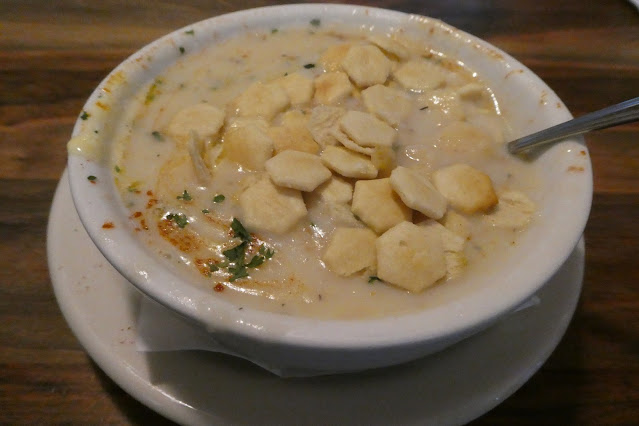
The soup comes with oyster crackers, as all must, and with melted butter on top along with a sprinkle of paprika.  The melted butter really is a special touch. You DO NOT eat New England Clam Chowder to lose weight, so stir the butter in, and enjoy it.  The texture is thick and creamy.  The taste has just the right amount of clam flavor.  You can tell that this stuff does not come from a carton or a can.  Soups thickened with a roux have that luxurious mouth feel, as this one does.  You can see other diners occasionally give that look - you know, eyes mostly closed, or rolled up in joy - like tasting a fine chocolate.   It's the real deal.  You could have bought it 50 years ago, and you're likely to be able to buy it 50 years from now.

One of the marks of a successful chowder is not needing to add salt or pepper.  The Sea Hag's chowder does not need anything.  It really hits all of the high notes.  The Impatient Chef highly recommends it, and hereby proclaims that the benchmark for clam chowders in future reviews will be the Sea Hag scale.  

The rest of the meal consisted of Shrimp & Chips, and Fish & Chips.


The shrimp, again, was very good.  The breading was crispy, with very little fryer oil taste, and the shrimp was not overdone.  If I had one complaint, it was that the cocktail sauce needed more horseradish.  


The Impatient Chef had the Fish & Chips.  Note that we got smaller portions on purpose.  Their normal serving is larger.  Like the shrimp, the breading was excellent, and the flavor was good.  The tarter sauce was very good, and not too sweet.


The fries were average.  They started out somewhat crispy, but did not fare well as they cooled.  They did not pass the salt test, which is that the fries are good enough to not require ketchup even as they cool, and the only seasoning necessary is salt.  


All and all, I gave it an 8 on the Rose & Thistle Scale. 

We traveled back to the Sea Hag in May, 2021, and the results were less consistent.  This was a little disappointing.  


We ordered the combination platter.  There was no change in the fries, tarter sauce, or shrimp, but the fish had changed, and not for the better.  The breading was light, and not crisp, and fell off easily.  The fish (cod) tasted very good, but it was let down by the breading.  This was odd, because the breading on the other items, shrimp, oysters, and scallops was very good.  I'm not sure how it happened.  The Fish & Chips part of the platter rated a 6 on the Rose & Thistle Scale.  The oysters were their usual, gamey selves.  The Impatient Chef refers to them as "Mutton of the Sea".  They are an acquired taste as long as you don't think about what you are eating.  The scallops were much cleaner tasting, and rather divine in the cocktail sauce (which could still use a little more horseradish), and the shrimp, well, the shrimp was as always excellent.  

Next, however, was a real treat: Deep Fried Pickles.


And these really were a treat. There was crunch on the pickle and crisp on the breading. The pickle was flavorful, tart, but not vinegary. The Ranch dressing not overpowering. The breading was crispy, and with very little oil flavor. The portion was just right. They were the best deep fried pickles I’ve had. If the fish had been given the same treatment, it would have maintained its rating of 8 on the Rose & Thistle Scale.  

If you are within striking distance, give Gracie's a try.  A 6 on the Rose & Thistle Scale is still not bad, but it's the chowder that wins the day.  It's the best on the Oregon Coast.  

Monday, April 26, 2021

The Impatient Chef Recipe: Chicken Schnitzel with Spaetzle and Mushroom Gravy


There is something about a mushroom gravy that just makes everything bad in the world go away for a short time.  The Impatient Chef has some German ancestry, and spent a couple of years there in the 1980's, and so retains some affinity for food that goes well with beer. 

There is really no better example of German cooking than the schnitzel, whether it be chicken or jager, and a side of spaetzle.  Sure, if you lived in Idar Oberstein, you would think that Speisbraten was the pinnacle of German cooking.  If you lived in Hamburg, or Frankfurt, you probably wouldn't think the hamburgers or frankfurters were the best, but you may like sauerbraten.  If you lived in Berlin, you may like ein Berliner.  John F. Kennedy called himself ein Berliner, not knowing that putting "ein" in front of "Berliner" makes him not a resident of Berlin, but rather, a jelly donut.  JFK called himself a jelly donut when he said "Ich bin ein Berliner" all those years ago.  Berliners loved him for that.  

The Impatient Chef makes a couple of impatient choices for ingredients that don't affect deliciousness.  These are store-bought spaetzle, and mushroom bouillon.  

Special tools:

  • A kitchen mallet.
  • A deep fryer, or a large dutch oven for frying.  
  • 3 pie plates for breading.

Ingredients: 

  • 2 half chicken breasts, boneless and skinless, and beaten flat with a kitchen mallet
  • 1/2 cup bread crumbs
  • 1 egg
  • 1/3 cup flour, and 6 tbsp flour for roux
  • salt and pepper to taste
  • 2 tsp mushroom bouillon (Better Than Bouillon works best)
  • 5 tbsp butter
  • 1 tbsp grapeseed oil (or another neutral oil)
  • 4 large crimini mushrooms
  • 1/2 tsp MSG (yes, The Impatient Chef dares to use this ingredient)
  • 2 cups dry spaetzle.  

Directions:

In a stock pot, heat water for boiling spaetzel.  Prepare and turn on the fryer, or put peanut oil into a dutch oven, and heat to 360 degrees F.  If you are using a dutch oven, take extra care not to fill it too far.  These breasts will make the oil level rise a surprising amount.  

While the water and oil are heating, divide the half chicken breasts again in half, and lay on some butcher paper, or wax paper.  Lay some plastic wrap over it, and pound the chicken breasts with a kitchen mallet.  Use the tenderizing end of the mallet.  Make them about 1/4" thick.  They can be thicker, but they will get even thicker in the fryer.  You want them to be fairly thin.  

Place 3 pie plates side by side on a table.  In the one on the left, put 1/3 cup four.  In the center one, beat the egg, and in the right one, put the bread crumbs, and a pinch of salt and pepper.  Coat the breasts in flour, egg, and then the bread crumbs.  Lay them out on a tray with a wire rack on it.  

When the water boils, add the spaetzel, and stir to keep them from sticking.  Stir occasionally while doing the rest of the recipe.  

Slice the mushrooms.  Melt 2 tbsp butter in a sauce pan, add the grapeseed oil, and sauté the mushrooms  with a 1/2 tsp salt and 1/4 tsp pepper until tender and fragrant.  Add 1 1/2 cups water, MSG, the bouillon.  Bring to a boil on medium heat while you make the roux.

To make the roux, melt 3 tbsp butter on medium low heat, and add 6 tbsp cup flour.  Stir often for 5 minutes, then add 1/4 cup water.  Stir until it is absorbed, and then add the last 1/4 cup.  Stir until it is absorbed.  Add roux to the mushroom broth, lower heat, and bring slowly to a boil.  

While the gravy is heating, add chicken to the fryer.  Make sure it is up to temperature first.  If you have timed it right, everything should be done around the same time.  Fry the chicken until golden brown, with an internal temperature of 165 degrees F.  Remove from oil.  

Drain the spaetzel when it is soft.  Serve with spaetzel on the side.  Ladle mushroom gravy over both.  Serves 4.  


Sunday, April 18, 2021

The Impatient Chef Celebrates the Anniversary of the Great Cajun Shrimp Boil


It's been a year since I posted the Shrimp Boil recipe, and I have made it quite a few times since then.  Today I made a change.  Not to the recipe, but to the cooking method.

Enter: The Multi-Cooker.


The Impatient Chef is a cast iron pan kind of cook.  Give him a heavy pan, and a steady fire to sail her by, and you'll be in supper heaven before the sun sets.  So the Multi-Cooker seems like a sharp turn through the guardrails of cookware preference, and a fiery crash into the ravine of trendiness. But, fear not, all is well.  There is a reason for this that is more practical than it may seem.  

The Impatient Chef owns a Jenn-Air stove, half of which is a grill.  The grill half is a complete waste of cook space.  It will never be used as intended because it would be impossible to clean.  That leaves only 2 usable burners.  If the Impatient Chef was wealthier, he would replace it.  We play the cards that are dealt, so the grill side serves mostly as a place to put the deep fryer, or as a bread cooling rack.  An induction hot plate added a third burner, and now the Multi-Cooker makes a fourth, and, more importantly, is both a pressure cooker, and steamer among other things.

The Multi-Cooker version of the Great Cajun Shrimp Boil uses 3 of the cooker's functions, and makes only one pot dirty.  It also speeds up the process.   The multi-cooker you use for this recipe should have these settings: pressure cook, sauté, and simmer.  

This recipe also parts with the previous by using frozen shelled and de-veined shrimp instead of fresh.

Ingredients:

  • 2 pounds frozen shrimp (shelled and de-veined)
  • 3 ears of corn
  • 4 andouille sausages (I use ones that are about 10" long. Use more sausages as necessary.
  • 1 1/2 lbs new potatoes (small and red), or other, just not russet. 
  • 8 cups water (including the shrimp broth) 
  • 7 large cloves garlic, pressed 
  • 3/4 cup hot sauce (Franks, or Louisiana Hot) 
  • 1/4 cup plus 1 tbsp Old Bay Seasoning 
  • 1/2 tsp cayenne pepper (or more if you dare) 
  • 1/2 stick of butter 
  • 1/2 tsp salt 
  • Freshly ground pepper to taste 
  • 1 1/2 tbsp Tony Chachere’s Cajun seasoning, or Buck’s Zestier BBQ seasoning

Directions:

I used the steamer basket for the potatoes, but used the pressure cook setting.  Go figure.  I think that they turn out better when not submerged in water.  I used a cup and a half of water.  


Prep: 

  1. Get the shrimp out of the freezer.
  2. Crush the garlic.
  3. Husk the corn, and cut each cob into 3 to 4 pieces
  4. Cut the sausage into 1" diagonal slices.
  5. Measure out the seasonings into a small dish.  
  6. Measure out the hot sauce.  
  7. Measure out the 6 cups of water.  

Cooking:  

  1. Add the potatoes to the steaming basket, put the lid on, and set the valve to Pressure.  Set the function for Pressure Cook/vegetables/high/5 minutes, and hit Start.
  2. When the cooker alerts you that it is done, Select Stop (or off), and let the steam out by turning the pressure valve to Steam, or by whatever means your multi-cooker uses to do the same thing.  Just don't open the lid before depressurizing the cooker.  Remove the potatoes, and dump out the water.   Set the potatoes aside.
  3. Set the cooker for 300 degrees/Sauté.  Hit Start.  Melt the butter, and add the garlic.  Sauté, stirring constantly for a minute, no more. 
  4. Select Stop on the cooker.  
  5. Immediately add water, and the corn.  If your cooker does not advise adding cold water to the hot kettle, warm it up first while completing the first 4 steps.  Put the lid on, and set the valve to Pressure.  Select Pressure Cook/vegetables/high/8 minutes, and hit Start.
  6. When the cooker indicates done, set the valve to Steam to vent the pressure.  
  7. Remove the lid, and add the potatoes, and sausage.  Add the spices and hot sauce.  Stir and put the lid on.  Leave the valve on Steam.  
  8. Set the cooker for Simmer/Soup/55 minutes.  You won't use all of that time, so if your cooker has smaller time settings, the total time should be 15 minutes when up to temperature.  Hit Start.
  9. Once the cooker indicates that it is up to temperature, set a timer for 10 minutes, or just look at a the clock on the cooker.
  10. After 10 minutes, remove the lid, add the shrimp, stir, and put the lid back on.  Let simmer for 5 more minutes total.  If your cooker uses some of that time to get back up to temperature before restarting the timer, the shrimp will be overdone.  It should be 5 minutes from the time you add the shrimp.
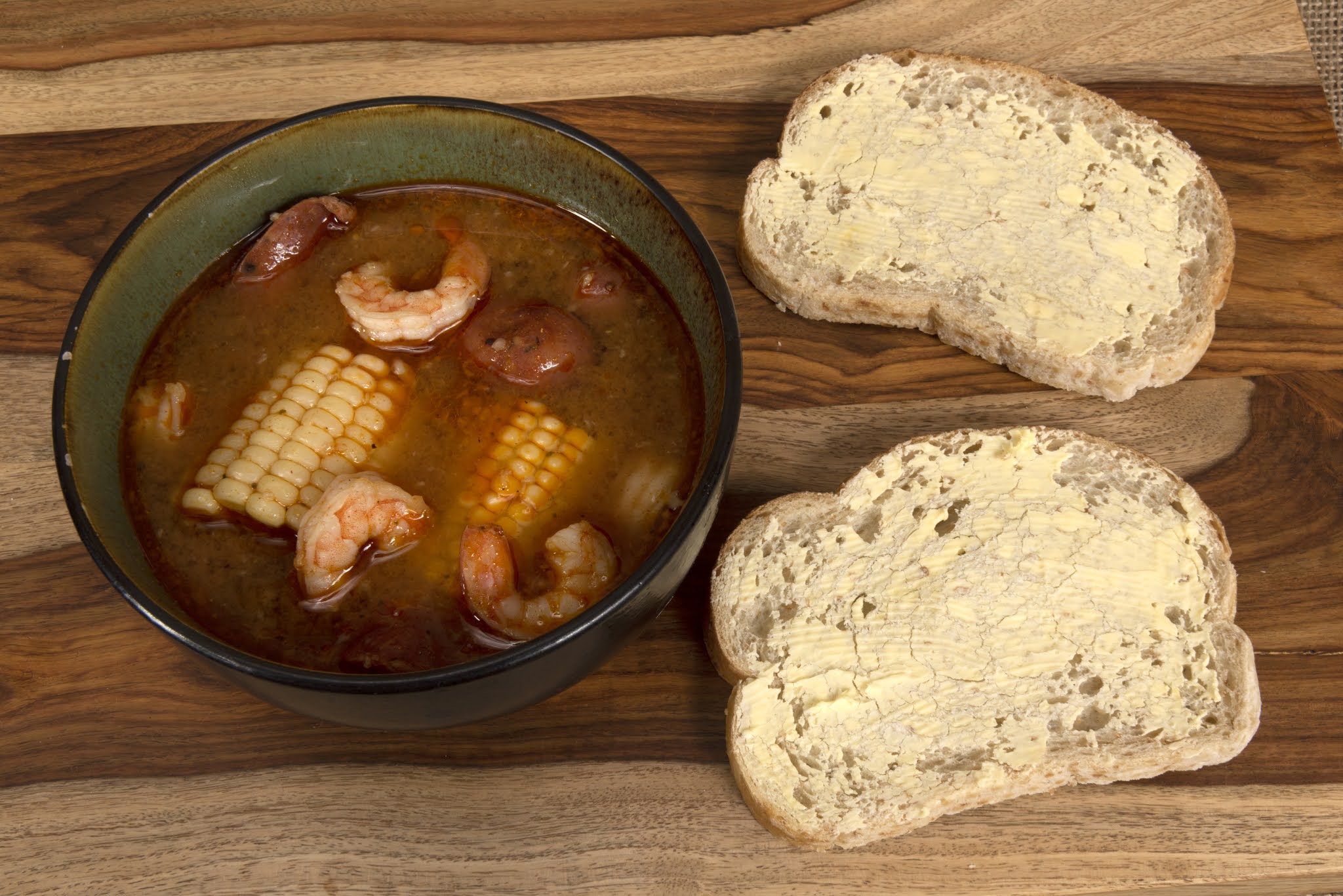
  11. Serve in a bowl with buttered sourdough bread on the side.  

Notes:  

This version streamlines the recipe quite a bit, and still yields a flavorful broth with the right hit of spice, and all of the high notes of the shrimp and sausage.  Total prep and cooking time was less than an hour.  Impatient Chefs everywhere rejoice!

Thanks for looking!

--The Impatient Chef.  


Thursday, April 15, 2021

The Impatient Chef Makes Quick Tomato Soup

So, this happened: We were tired, and really didn't want to cook. We weren't very hungry, either. What to do? I'll start by saying that I didn't take pictures, but I do have the recipe. 

This recipe is the epitome of The Impatient Chef: a delicious meal that does not take long to make. It is not what I would call gourmet, or even fine dining, but as Alton Brown says, it's good eats. First, the set up. I binge listened to Milk Street Radio (Christopher Kimball's new empire) over the past few weekends, and one of the things that stuck with me was the use of sugar in tomato sauce. I have avoided that for years, but I decided to be open to it after hearing it. 

 My wife and I were tired, and not very hungry, so I opted for a simple supper of store-bought tomato soup. I pulled a carton of soup down from the cupboard, and shook it up before pouring it into the pan. It was chicken stock, not tomato soup. Oy. Time to change gears. How to make a quick soup? I put together the following: 
  • 1/2 cup chicken broth 
  • 1 24.5 oz jar strained tomatoes 
  • 1/4 tsp garlic powder 
  • 1/2 tsp berberé 
  • salt and pepper to taste 
  • 2 tbsp honey 
 First taste was a little disappointing. It was on the bitter side despite the honey. Tomato soup usually gets mellowed out by some dairy, but we had only half and half, which needed to be saved for tomorrow's coffee. That's when inspiration struck. We had some leftover whipped cream in the "Whip It" dispenser. I served the soup in two bowls, and added a generous helping of the whipped cream, covering the entire top of the soup by about an inch or more. That made the difference. It was a decent soup for a total prep and cooking time of about 15 minutes. 

 Thanks for looking! 

 --The Impatient Chef.

The Impatient Chef Kvetch: Forks Matter

The Fairview Fork  Preface:  The Impatient Chef loves food carts.  He is a champion of the small time chef with big dreams and small pockets...